The Market Summary

Nvidia’s Scandal Spreads From the Boardroom to Congress

Let’s start with stocks. The S&P 500 fell 0.35% yesterday after Nvidia CEO Jensen Huang’s sudden resignation rattled investors. The Dow also lost 0.36%, and the Nasdaq fell 0.39%, giving back some of Wednesday’s gains. Nvidia’s shares closed down 4.3%, while investors moved money into rival chipmakers AMD and Broadcom, both of which rose more than 5%. 

Jensen Huang resigned after reports that he had affairs with an Nvidia executive and with a Chinese businesswoman U.S. intelligence officials suspect of spying for Beijing. China has rejected the spying claims. Hours later, Reuters reported a third relationship with another Nvidia employee. Huang had run Nvidia since its founding in 1993, and a top House Republican says he has agreed to testify before Congress. Finance chief Colette Kress is serving as interim CEO.

Shoppers slowed their spending in October. Retail sales rose 0.2% from September, the slowest monthly gain in nearly a year, according to the CNBC/NRF Retail Monitor. Sales were still up 3.6% from a year earlier heading into the holiday season.

What to watch: Nvidia reports quarterly results Tuesday, its first report since Huang’s exit. SpaceX is also targeting today for the 15th test flight of its Starship rocket.

Flying together with our sponsor

The Flyover

Could the AI Boom Hit a Power Problem?

The AI race depends on more than powerful computer chips. It also needs electricity, and plenty of it.

Joel Litman, a professor who has lectured at Harvard and Wharton, warns that America’s grid faces a $33 trillion crisis that could ignite as soon as Dec. 10. His concern: A power bottleneck could have consequences far beyond the technology sector, potentially affecting stocks millions of Americans hold.

Altimetry’s latest presentation identifies 10 widely held stocks Litman recommends selling. Some may already be in your portfolio.

But he also sees a potential opportunity. As tech companies pour capital into addressing their power needs, Litman believes an emerging technology could help relieve the strain and create substantial opportunities for three little-known stocks.

See the 10 stocks on his warning list and the three he’s watching.

Buy, Sell, Hold

➤ Buy: Deutsche Bank upgraded Dove and Vaseline maker Unilever (UL) from Hold to Buy. The bank thinks Unilever is big enough to hold up better than smaller rivals as AI changes the consumer-products business, and it expects soap, shampoo, and cleaning sales to grow about 4.6% next year. (More)

➤ Hold: Piper Sandler downgraded Cheerios maker General Mills (GIS) from Buy to Hold. Piper sees risk to the dividend, since payouts have eaten up about 85% of the cash left over after running the business, and General Mills is carrying more debt than it wants. (More)

➤ Hold: Bernstein downgraded ConocoPhillips (COP) from Buy to Hold. Bernstein expects tensions with Iran to ease after the midterms and says oil around $80 a barrel next year would be good for oil companies but not for their stocks. (More)

Chart of the Day

Home Sales

2021 to October 2026

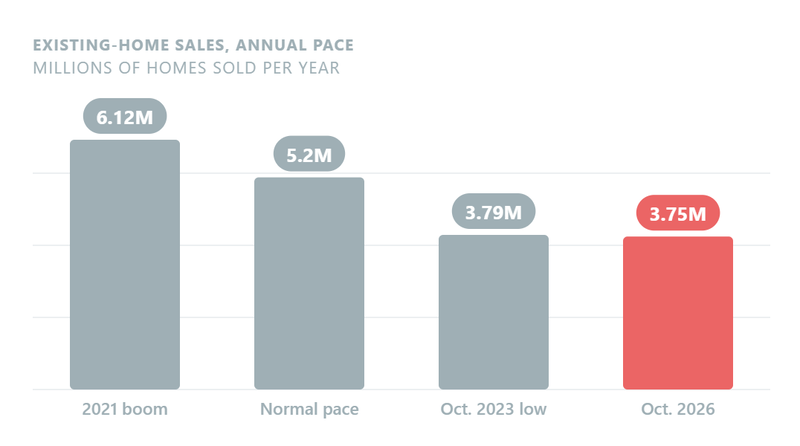
Home sales are running nearly 40% below their 2021 pace, at 3.75 million.

➤ Home sales fell 5.5% in October to an annual pace of 3.75 million, the slowest since August 2010. That’s below the October 2023 low and well short of the roughly 5.2 million homes that sell in a normal year.
Mortgage rates are the main reason. The average 30-year rate reached 7.4% in early October, its highest in nearly three years. Prices haven’t fallen with sales. The median home sold for $416,700, up 0.4% from a year earlier and the 40th straight month of annual gains.

Source: National Association of Realtors.

The Rotator

Retirement Strategy

Savers can put $1,000 more into 401(k)s next year.

The IRS raised the 401(k) contribution limit for 2027 to $25,500, up $1,000 from this year. The limit for IRAs stays at $7,500.

The IRS adjusts these limits each year to keep up with inflation. The new cap also covers 403(b) plans for teachers and nonprofit workers, as well as the Thrift Savings Plan for federal employees.

Anyone 50 or older can add a catch-up contribution of $8,500, up $500 from this year. Workers ages 60 to 63 get a larger catch-up contribution of $11,750, so they can put away up to $37,250.

Workers who earn more than $155,000 in wages this year must put next year’s catch-up money into a Roth account. They’ll pay income tax on it now rather than get a deduction, though withdrawals in retirement are generally tax-free.

The income limits for Roth IRAs moved up, too. Married couples can make a full contribution with income up to $250,000, up from $242,000, and the option phases out completely at $260,000.

Loose Change

➤ Corteva shares fell nearly 20% after the crop-chemical maker cut its outlook on weaker sales in Brazil. (More)

➤ Cisco raised its forecast for the year after quarterly revenue jumped 24% to $18.5 billion on strong demand for its networking gear. (More)

➤ Kraft Heinz expects sales to stay flat next year before returning to growth in the second half under its turnaround plan. (More)

Reader Sentiment

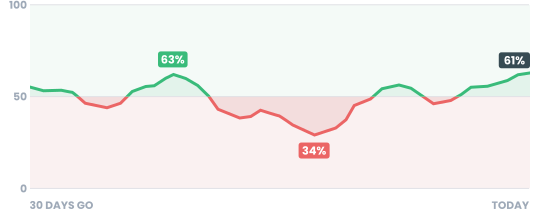
▲ BULLISH · 61%

Composite score based on our previous edition’s votes.

How do you feel about the economy today?

Bullish Bearish

Finance Quiz

Is child support taxable federal income?

Show Answer

Flyover

Join Flyover Finance

Facebook Icon Instagram Icon Twitter Icon LinkedIn Icon